
Overview
With a focus on what moves each learner, HMH delivers what educators need to foster growth and build lasting momentum. The company creates integrated K–12 learning solutions for core, supplemental, intervention, assessment, and professional learning—delivered on one streamlined platform.
There is a need to understand how to better support Read 180 students in developing and applying complex comprehension skills, given current performance levels and limited in-task support. To inform this, the study gathers teacher perspectives to identify which scaffolds are most effective for intervention students and how they should be integrated into the learning experience.
Note
Please note that only a few parts of the projects are shared to ensure compliance with HMH’s NDA.
Impact
Reading intervention is a high-stakes challenge: in 2024, 40% of U.S. fourth-graders and 33% of eighth-graders performed below NAEP Basic in reading. HMH reports that Read 180 has reached 10 million students across 40,000 classrooms, giving design decisions within the product the potential to operate at significant scale.
My research identified where the proposed comprehension experience could break down for students at different ages and reading-readiness levels. The findings directly informed changes to four parts of the experience: the passage content was revised, prompts were redesigned, the experience was differentiated by age and grade level, and the badge/incentive approach was changed.
By surfacing these issues before implementation, the research helped the team move away from a one-size-fits-all concept and toward an experience better aligned with the needs of students across grades 3–8—within a product specifically designed to support students reading below grade level.
Approach
Data Collection
Instrument: Open-ended interview guide
Main study: 11 grade 3-8 teachers
Data Analysis
Thematic Analysis
Team
Number of Team Members: 10
My Role: Principal Researcher
Methodology
Research Approach: Qualitative
Research Method: Moderated concept testing using an interactive prototype
Prototype
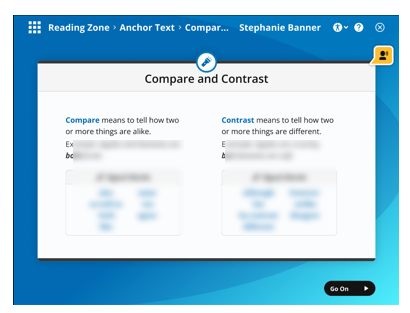
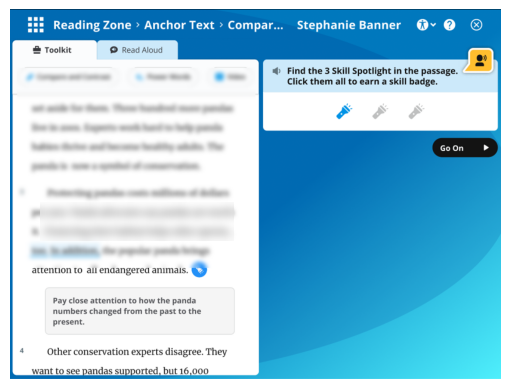
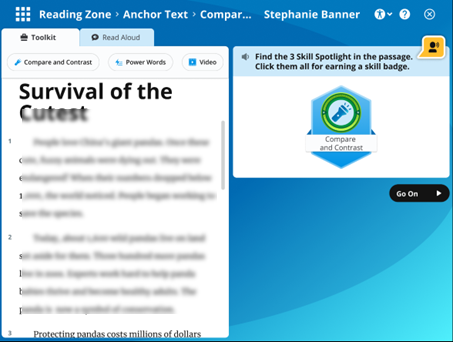
Key Insights
1- Teachers across grade bands see the compare-and-contrast instruction as useful, but they consistently point to a mismatch between the lesson design and students’ readiness: it assumes prior knowledge for younger students, places reading demands that some students avoid, and feels too simple and passive for older students.
2- Teachers said the supports effectively draw attention to compare-and-contrast elements, but their effectiveness may be limited if students do not understand what they are comparing, if the text and blurbs are too high level, if audio read-aloud is not available, or if the supports are optional and may be skipped.
3- Across participants, the main view is that an animated badge alone is unlikely to motivate students to access the prompts. Multiple participants said students won’t click unless there is an end prize, a contest/collection incentive, or the prompts are forced to be able to move forward.